

The recent vote at the United Nations does not merely raise a political question. It raises a civilizational one. Why are we attempting to rank humanity’s brutality at all?
The motion, introduced by Ghana and passed by the United Nations General Assembly this week, declared the transatlantic enslavement of Africans “the gravest crime against humanity” and linked that recognition to calls for reparatory justice. The resolution passed with 123 votes in favor, while the US, Israel, and Argentina voted against, and dozens of others, including the UK and EU states, abstained. The vote is politically significant, but it is also non-binding, which means it functions more as a moral and symbolic declaration than an enforceable instrument of law. General Assembly resolutions are not legally binding on states in the way many people assume.
On the surface, this resolution can be read as an overdue acknowledgment of one of history’s most devastating crimes. And in one sense, it is. UNESCO has repeatedly documented the transatlantic slave trade as one of the largest forced displacements in human history, with millions of Africans uprooted, commodified, brutalized, and absorbed into an economic order built on racialized extraction. That horror deserves naming. It deserves remembrance. It deserves intellectual and moral seriousness.
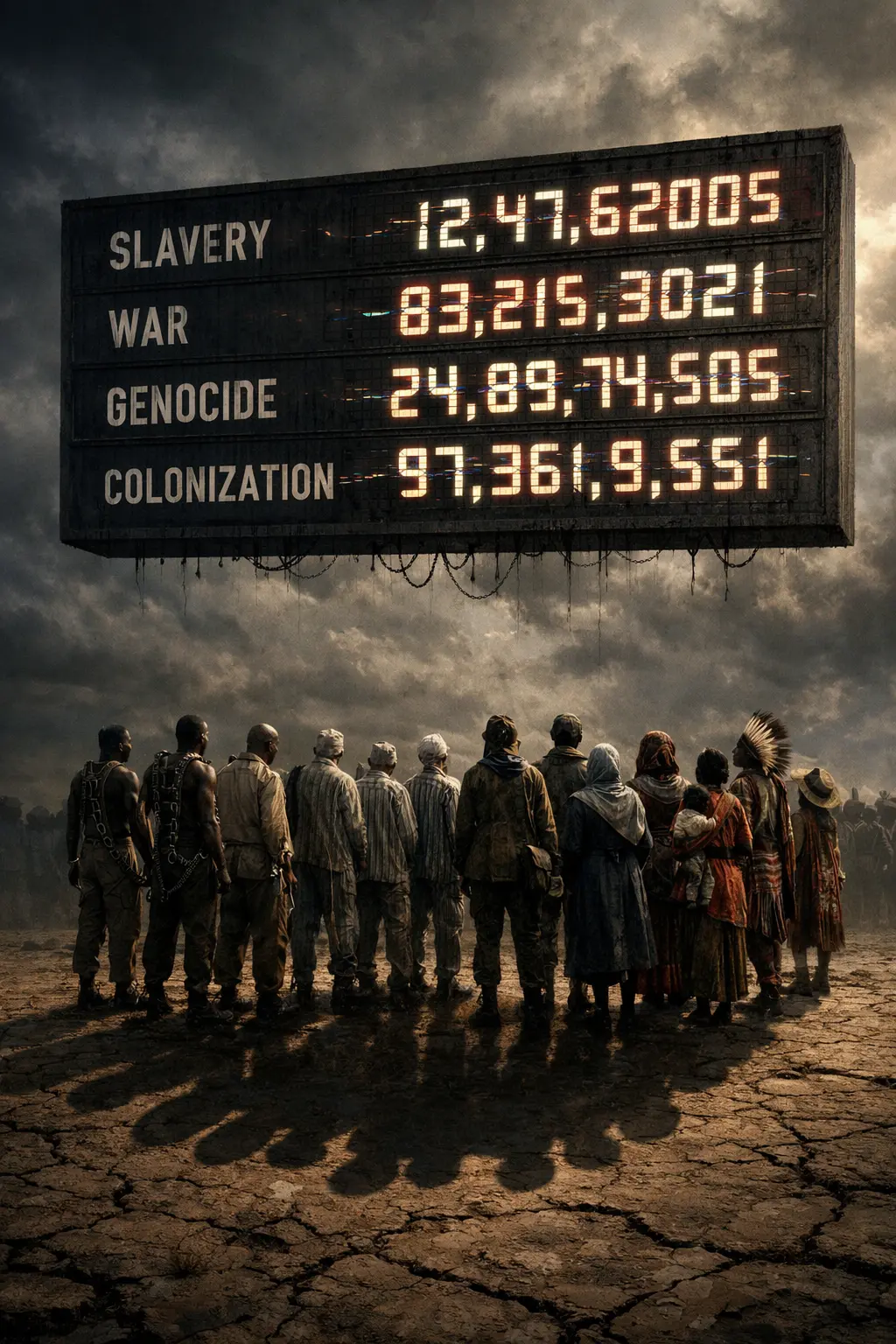
But beneath the symbolic dignity of this recognition lies a contradiction that far too few are willing to confront honestly. The very act of ranking suffering suggests that atrocity can be arranged into a hierarchy, that brutality can be calibrated, and that history can be turned into a scoreboard of human ruin. It suggests that some crimes sit at the summit of evil, while others, by implication, fall somewhere below. And once we enter that terrain, we are no longer simply remembering the dead. We are adjudicating whose deaths matter most.
That instinct is older than the UN and uglier than diplomacy. Human societies have always been tempted to quantify tragedy. How many died? How long did the suffering endure? How deeply did it reshape the future? Historians generally estimate that roughly 12 to 15 million Africans were forcibly transported across the Atlantic between the 16th and 19th centuries, though the number brutalized by the system itself extends far beyond those who survived the Middle Passage. Entire lineages were shattered before they ever reached a ship. Entire worlds were reorganized around the premise that Black life could be converted into capital.
And yet if numbers are to be our metric, then how exactly are we supposed to rank other atrocities? The Second World War alone is estimated to have resulted in roughly 80 million deaths. Around half were civilians. The Holocaust systematically annihilated six million Jews, alongside Roma, disabled people, political dissidents, homosexuals, Slavs, and others marked for removal. In some countries, Jewish life was not merely wounded but nearly erased. In Eastern Europe, whole towns vanished into memory. In Asia, entire populations endured occupation, biological warfare, sexual slavery, mass rape, famine, and imperial brutality. In the Americas, indigenous civilizations were decimated, displaced, converted, erased, or reduced into caricatures of themselves.
So what exactly is being measured here? Duration? Scale? Cruelty? Cultural destruction? Economic consequence? Intergenerational trauma? Civilian toll? Psychological inheritance? If a people are exterminated in five years, is that “graver” than a people degraded over three hundred? If a civilization is enslaved, if another is exterminated, if another is displaced, if another is colonized into internal collapse… which one deserves the gold medal of human evil?
The question itself is morally malformed. There is no meaningful comparison between a life lost in a gas chamber and a life lived in chains. There is no scale that can measure the anguish of a mother watching her child taken into slavery against the anguish of a family annihilated in war or occupation. Each represents a complete moral collapse. Each stands as an absolute failure of human consciousness.
More than that, to rank suffering by proximity is to preserve the same discriminatory instinct that gave birth to oppression in the first place: the belief that some pain matters more because it is ours. When we elevate the suffering closest to our own lineage, geography, religion, or collective memory above all others, we are not transcending tribalism, we are refining it. To favor one wound because it is ours is still a form of discrimination. It is still the selective endorsement of human pain.
And this is where the hypocrisy becomes especially dangerous. Many people who would rightly condemn selective empathy in daily life become selective the moment history enters the room. Suddenly, compassion becomes tribal. Suddenly, memory becomes territorial. Suddenly, justice is not about ending the logic of suffering, but about securing moral priority for one’s own group. This is not only a political problem, but an aesthetic one in the sense explored by Friedrich Nietzsche. Morality often presents itself not as an objective truth, but as a curated expression of taste, preference, and identity. What we choose to elevate, memorialize, and ritualize is not neutral. It reflects what we find beautiful, tragic, worthy, or sacred. And in that sense, the ranking of suffering becomes an aesthetic exercise disguised as ethics, where certain pains are stylized into moral monuments while others are left unframed, unspoken, and unseen. That is not liberation. That is merely a more articulate form of collective narcissism.
The deeper issue, then, is not simply the vote itself but the logic behind it. What does humanity gain by determining that one crime is graver than another? Does such a declaration prevent future atrocities? Does it create a meaningful framework for healing? Or does it merely convert historical pain into political currency?
That last question matters, because once reparations enter the conversation, moral recognition and political incentive become impossible to separate. The call for reparations is not inherently unserious. In fact, there are credible arguments for it. The Caribbean Community Reparations Commission, among others, has argued that slavery and colonialism were not isolated historical episodes but foundational systems that generated long-term global inequality. That claim is not difficult to defend. The wealth of modern empires was not produced in abstraction. It was extracted through labor, land theft, resource theft, racial hierarchy, and coercive trade structures whose consequences did not vanish when legal slavery ended.
But this is precisely why the discussion must be handled with intellectual precision rather than emotional theatrics. Because the moment reparations become attached to a ranking exercise, we are no longer simply discussing historical repair. We are constructing a marketplace of grievance.
Who pays whom? That is not a cynical question. It is the unavoidable question. Who is morally, legally, politically, and economically responsible for the crimes of history when the entities that committed them no longer exist in the same form? The modern nation-state is not a frozen object. Borders shift. Empires collapse. Governments mutate. Constitutions are rewritten. Populations mix. Legal regimes die and are reborn under new flags.
During the era of slavery, the current US was not a morally unified entity but a deeply divided one. Northern states abolished slavery and ultimately fought a war against Southern states that defended and depended upon it. Canada became a refuge for many fleeing enslavement. So if reparations are to be structured through present-day state continuity, what exactly is the moral formula? Do some American states owe while others are partially exempt? Does historical opposition to slavery reduce liability? Do regions that materially benefited but later politically opposed the institution receive partial absolution? These are not rhetorical distractions. They are the practical consequences of turning historical recognition into distributable compensation.
And if we are serious enough to ask those questions of Europe and North America, then intellectual honesty demands we ask them elsewhere too. Historical research by scholars such as John Thornton has documented that some African political elites and trading intermediaries were not passive spectators to the slave trade but active participants in capturing and selling human beings into it. This does not remotely absolve European empires of their industrialized, racialized, transoceanic machinery of enslavement. But it does demolish the comforting fiction that historical evil can always be divided cleanly into geographic innocence and geographic guilt.
The same problem widens the moment one tries to universalize the principle. If reparatory claims are grounded in historical devastation, then on what basis are some devastations admitted and others excluded? Do descendants of victims of the Mongol conquests seek restitution? Do colonized indigenous nations across the Americas, many of whom do not possess equivalent geopolitical representation, get equal standing in this moral economy? Do Armenians, Assyrians, Roma, Yazidis, Congolese, Aboriginal peoples, or descendants of Ottoman, Soviet, Japanese, Belgian, Spanish, Portuguese, British, French, or Arab imperial violence all queue into the same historical tribunal? And if they do, who is left solvent by the end of it?
The point is not that reparations are absurd. The point is that selective reparations framed through selective historical ranking quickly become a political theater of inconsistency. And theater is exactly what much of this is. Because the vote itself, however emotionally resonant, does not compel restitution. It does not create a reparations court. It does not trigger automatic liability. It does not seize assets. It does not legislate payment. It does not even establish a coherent mechanism of implementation. As basic international law confirms, this was a symbolic General Assembly resolution; morally loud, legally soft.
That matters, because much of what passes for international justice today is really public relations with flags. Nations posture. Blocs abstain. Diplomats phrase their hypocrisies in elegant language. One country denounces history while financing present-day brutality. Another abstains not because it is neutral but because neutrality is the cheapest way to avoid moral exposure. Silence in international politics is rarely silence. It is managed positioning.
And the voting pattern here tells its own story. The US, Israel, and Argentina voted against the resolution, while the UK and EU largely abstained. These are not random alignments. They are geopolitical reflexes.
The US, one of the clearest historical beneficiaries of racial slavery and post-slavery racial capitalism, has obvious financial and political reasons to resist any framework that could mature into reparatory expectation. The UK, which helped engineer and profit from the global architecture of empire, has for years preferred the language of regret over the language of liability. Abstention, in that sense, is not indecision. It is reputational self-defense.
And then there is Israel, or more precisely, the current Israeli state and its ruling ideology. Here, one must be careful and precise. The Jewish people are not the Israeli state, and historical Jewish suffering must never be collapsed into the policies of a government. But precisely because that distinction matters, it becomes all the more revealing when a state that derives part of its moral legitimacy from the memory of historical atrocity votes against symbolic recognition of another people’s civilizational wound while continuing to preside over a catastrophe that large parts of the world increasingly understand through the language of ethnic cleansing, apartheid, and genocidal intent. That contradiction does not erase Jewish suffering. It exposes what happens when suffering is converted into state capital rather than moral consciousness.
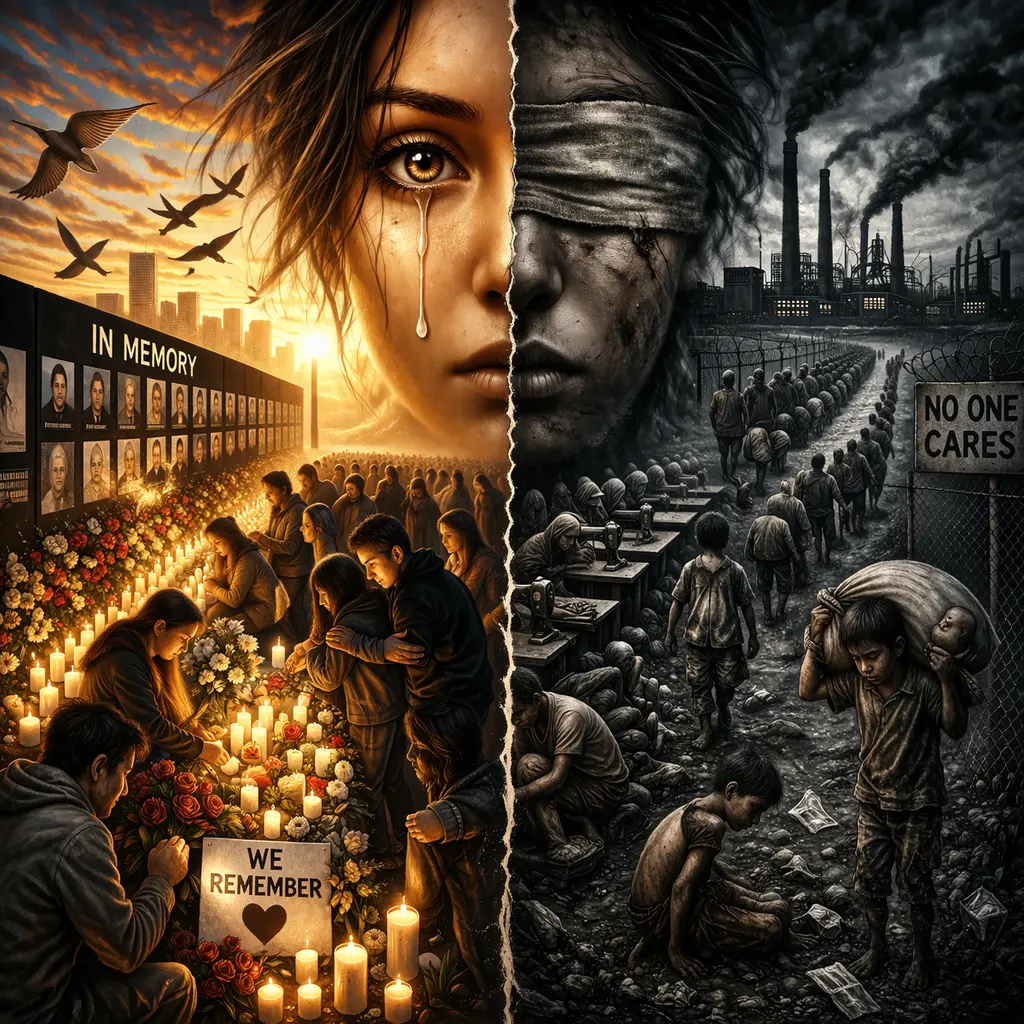
And that is the real danger of this entire discourse. Once historical pain becomes political currency, memory itself becomes corruptible. One group’s trauma becomes diplomatic leverage. Another group’s trauma becomes inconvenient. One atrocity is taught in schools. Another is softened into euphemism. One people are told never to forget. Another are told to move on. One catastrophe becomes sacred memory. Another becomes statistical background noise. This is not healing. It is hierarchy. And hierarchy is precisely what every atrocity system depends upon. Which is why the most uncomfortable truth in this entire discussion is the one least addressed by ceremonial institutions: Slavery did not disappear. It evolved.
According to the International Labour Organization (ILO), the International Organization for Migration, and Walk Free, over 50 million people were living in modern slavery in 2021, including roughly 28 million in forced labor and 22 million in forced marriage. The ILO states plainly that most forced labor today exists in the private economy. Not in some hidden medieval cave. In the private economy. In supply chains. In agriculture. In domestic labor. In construction. In manufacturing. In services. In the ordinary bloodstream of global commerce.
So what exactly are we doing when we solemnly vote to condemn slavery in history while structurally consuming its descendants in the present? The modern economy, often sold to us as the triumph of freedom, still relies on labor arrangements that are coercive in everything but legal vocabulary. People are not always owned, but they are trapped. They are indebted, underpaid, outsourced, undocumented, deportable, disposable, and economically cornered. Their freedom is often merely the legal permission to choose between different forms of desperation. That is why capitalism must be confronted directly and not merely alluded to politely.
Traditional slavery was expensive. You had to own the body, feed it, house it, police it, maintain it, and absorb the cost of its survival. Capitalism, in many of its dominant forms, improved the model. It found a cheaper way to exploit human beings: Do not own them, simply make survival contingent upon their submission. Externalize the cost of their existence. Let debt discipline them. Let immigration status discipline them. Let housing costs discipline them. Let healthcare costs discipline them. Let inflation discipline them. Let unemployment discipline them. Let precarity discipline them. Then call them free.
That is not a conspiracy. That is an economic design. And it is not confined to one race or region. It moves through migrant labor camps in the Persian Gulf, cobalt extraction in Central Africa, garment factories in South Asia, prison labor in the US, domestic labor across wealthy households, exploited agricultural labor across continents, and the invisible subcontracting architecture that allows middle class consumers to enjoy moral innocence at retail prices.
This is why ranking historical suffering while preserving present-day exploitation is not merely inconsistent. It is obscene. Because the real crime against humanity is not only what we once did, way back when, in history. It is the recurring human creativity that keeps redesigning domination in more efficient forms.
That is the deeper continuity between slavery, genocide, colonization, apartheid, ethnic cleansing, and organized war. They do not begin with weapons. They begin with permission. They begin with ideas. They begin with a conceptual appointment within the human mind that says some lives can be used, some can be displaced, some can be managed, some can be starved, some can be caged, some can be bombed, some can be forgotten. By the time the violence becomes visible, the philosophy has already won.
This is why the current discourse falls short even when it sounds morally serious. By focusing on which crime is the gravest, we risk ignoring the shared logic that connects them all. Whether it is slavery, genocide, colonization, or war, each is rooted in the same spiritual and civilizational disease: the belief that some lives are worth less than others and can therefore be converted into means. That belief is the true crime. It is the crime before the crime. And until that is confronted, we will continue doing what humanity does best: condemning one form of brutality while funding the next.
This is also why historical recovery must be spoken about more honestly. Yes, Africa still bears the structural consequences of slavery and colonialism. That is real. Yes, anti-Blackness remains globally embedded. That is real. Yes, wealth extraction and historical sabotage matter. That is real. But history also shows that civilizations can rebuild after devastation when the conditions of internal renewal, institutional seriousness, and developmental coherence are present. Japan rebuilt after nuclear catastrophe. Germany rebuilt after civilizational disgrace and physical ruin. Jewish communities rebuilt cultural and intellectual life after centuries of expulsion, pogrom, and genocide. None of this minimizes what was done to them. It simply means that historical injury, while real, cannot become an eternal substitute for structural responsibility in the present.
This is where we refuse two temptations at once: the temptation to deny historical harm, and the temptation to turn historical harm into a permanent explanatory monopoly. If we are serious about healing humanity, then our task is not to determine whose suffering deserves the highest throne. Our task is to dismantle the mental, political, and economic architecture that keeps manufacturing suffering at scale. That requires something far more difficult than a vote.
And this is where we move beyond observation into responsibility. It is not enough to merely notice the hypocrisy, name the contradiction, or intellectually diagnose the disease. Humanity is now drowning in analysis while starving for implementation. The real question is not whether we can see the flaw, but whether we are willing to reorganize our systems around a higher moral intelligence. How do we educate differently? How do we legislate differently? How do we build economies, institutions, and public cultures that are no longer dependent on selective suffering for their stability? None of that becomes possible if the people chosen to lead us are themselves still trapped in competitive victimhood, nationalist vanity, civilizational scorekeeping, and the primitive urge to own tragedies and victories as instruments of leverage.
A species cannot advance into harmony while its leadership class is still psychologically organized around advantage, image, retaliation, and market gain. The first step toward improvement is either for leaders to rise to a higher calling or for the public to replace spiritually and politically inefficient leadership with people capable of governing toward a harmonious planet. Because if we continue down this divisive, segregational path, dressing fragmentation up as justice while quietly monetizing every fracture, we should stop pretending we are progressing.
That is not the road to healing. It is the road to societal deterioration, civilizational exhaustion, and eventual fragmentation. It requires the abolition of selective empathy. It requires an education system that teaches children not merely the pain of their own people, but the equal sacredness of all people (and animals). It requires economic systems that stop treating labor, land, memory, and bodies as extractable inventory. It requires political honesty strong enough to admit that many of the same nations and institutions that ceremonially condemn yesterday’s crimes are structurally reproducing their logic today. And it requires us to reject one of modernity’s most seductive lies: that suffering can be morally organized into a hierarchy without reproducing the very discrimination that made suffering possible. Suffering is not a competition. It is a warning.
The lesson of history is not that one atrocity outweighs another. The lesson is that all atrocities emerge from the same diseased permission structure: the willingness to selectively withdraw compassion in exchange for power, profit, identity, or convenience. Until that permission is destroyed at its root, humanity will keep doing what it has always done. It will hold memorials for the dead while building new machines to kill the living.