

We rarely question the words that shape our perception of the world. They arrive to us as neutral carriers of meaning, tools for communication, inherited structures that feel too ordinary to interrogate. Yet language is never neutral. It carries memory, power, hierarchy, and intention. It encodes the worldview of those who shaped it, and when repeated often enough, it begins to feel like truth rather than perspective. What we call something becomes an active decision about how reality will be framed, remembered, and justified. Language shaped in moments of domination preserves power, extending it beyond the moment of force and embedding it into perception, memory, and meaning.
There is a quiet but persistent energy embedded within modern vocabulary that traces back to a particular moment in history, a period when European expansion reshaped not only borders and economies, but the very architecture of meaning. From the fifteenth century onward, as new European powers extended themselves across continents, they did not arrive empty-handed. They carried with them a linguistic system that positioned themselves at the center of the world, and they named everything accordingly. Geography was not simply mapped; it was linguistically reorganized. Entire regions were defined relative to Europe, as though Europe itself were the axis around which all existence revolved. The term “Middle East” is a simple but revealing example. Middle to what? East of whom? The phrase contains within it an assumption so normalized that it often escapes notice: that Europe is the reference point, the center, the origin of orientation. The same applies to the term “Orient,” derived from the Latin for “rising,” used to describe the lands where the sun rises relative to Europe. It is not a universal designation. It is a directional claim rooted in one worldview, quietly imposed upon all others.
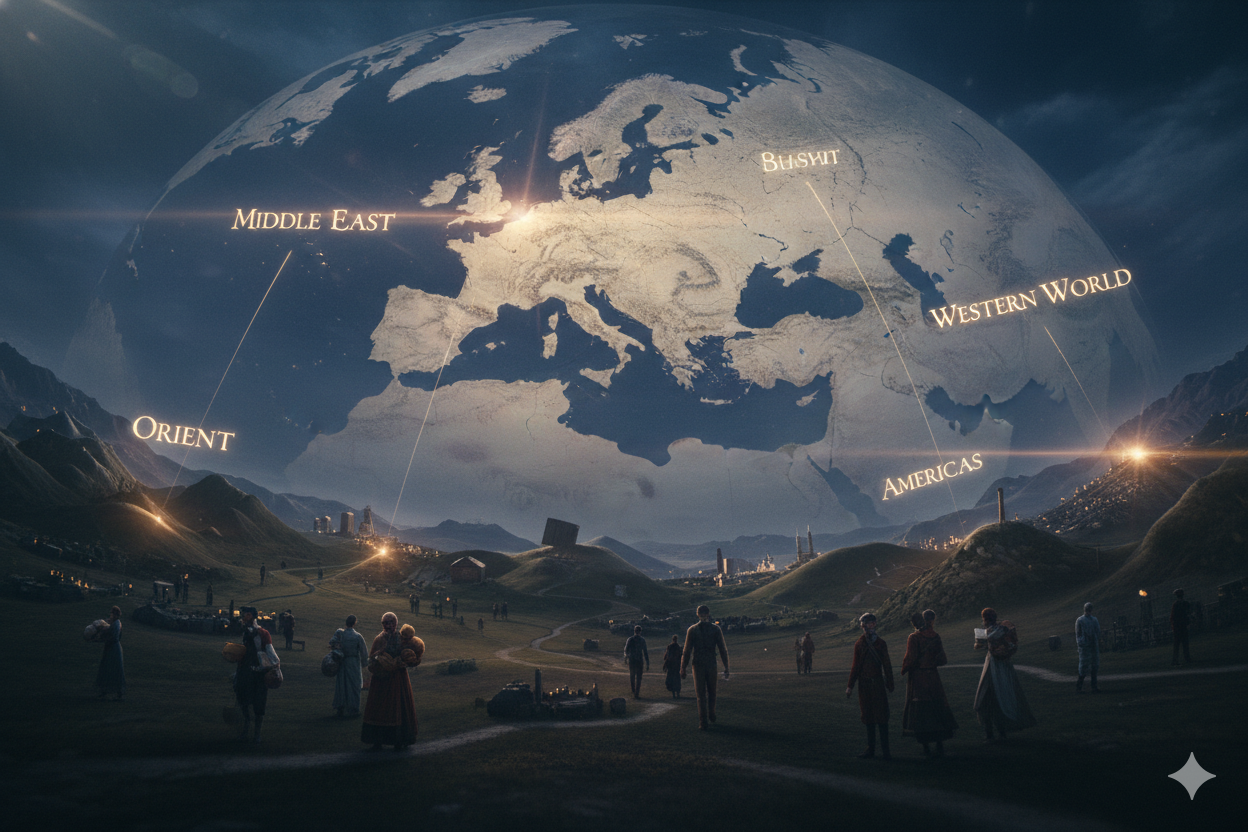
This pattern extends beyond geography into how societies are categorized. Terms like “Third World” and “developing countries” do not merely describe economic conditions; they construct a hierarchy of civilization. The phrase “Third World” emerged during the geopolitical tensions of the twentieth century, yet its enduring power lies in how it subtly assigns value. First implies priority, advancement, and superiority. Third suggests delay, deficiency, and inferiority. Even when replaced with softer alternatives such as “developing,” the implication remains intact. Developing toward what? Toward whom? The unspoken answer is often Europe or the Western model more broadly. Entire cultures are framed as incomplete versions of something else, as though their value lies in how closely they approximate a predetermined standard. This is not description. It is direction. It is a linguistic current that flows toward assimilation.
The language of movement reveals the same asymmetry. When individuals move from Europe or North America to other parts of the world, they are often described as expatriates. The term carries a sense of choice, adventure, even sophistication. It suggests someone temporarily residing elsewhere without losing their original status. Yet when movement occurs in the opposite direction, the language shifts. Those arriving in Europe are immigrants. The term, while not inherently negative, has been culturally loaded with implications of burden, adaptation, and scrutiny. Two individuals crossing borders, engaging in the same act of relocation, are linguistically separated into categories that reflect an underlying hierarchy of belonging. One retains identity. The other is required to renegotiate it.
This asymmetry becomes even more pronounced when we consider the designation of the refugee. The term carries not only a legal definition but a deep social connotation of displacement, instability, and escape from failure or crisis. Yet when individuals from Europe relocate due to economic hardship, political dissatisfaction, or personal unrest, they are rarely described in the same terms. They are not framed as refugees, even when their movement is driven by similar pressures. The distinction often rests less on circumstance and more on the perceived value of origin, reinforced by the invisible hierarchy embedded in passports and global mobility. In this way, language does not simply describe movement, it assigns dignity or deficiency to it, shaping how entire populations are perceived before they are even encountered.
Even the language of “aid” reflects this dynamic. Wealthier nations provide aid to poorer ones, a term that suggests generosity and benevolence. Yet it rarely acknowledges the historical processes that contributed to the disparities in the first place. Extraction, resource depletion, imposed economic systems, and centuries of imbalance are softened into a narrative of assistance. The language removes context and replaces it with virtue. It allows systems of inequality to continue, while presenting their consequences as opportunities for moral expression.
A revealing example is found in the relationship between Belgium and the Congo. During the late nineteenth and early twentieth centuries, the Congo Free State was subjected to one of the most brutal extractive regimes in modern history under King Leopold II, where rubber and other resources were harvested through forced labor, violence, and systemic terror. The wealth generated flowed outward, building infrastructure and prosperity in Europe, while the region itself was left destabilized and depleted. In later decades, assistance and development programs emerged, framed as aid to a struggling nation. Yet the language of aid rarely carries the full weight of that prior extraction. It presents a present-tense generosity without fully accounting for the historical transfer of value that shaped the very conditions being addressed. In this way, language reorganizes history, recasting prior exploitation as present compassion and obscuring the continuity between them.
There is another dimension of linguistic power that operates even more directly: the imposition of dominant languages themselves. Across many parts of the world, the ability to participate in economic, political, and educational systems is tied to the requirement to speak a language that is not native to the people themselves. English, in particular, has become a global gatekeeper. In countries where it is not indigenous, it remains the language of higher education, law, governance, and global opportunity. This is often framed as a practicality, a tool for connection in an interconnected world. Yet beneath that practicality lies a deeper consequence. When a language becomes required for advancement, other languages begin to disappear, along with the worlds they carry.
A clear and devastating example can be found in Canada’s residential school system, where Indigenous children were taken from their families and forced into institutions designed explicitly to erase their cultural identity. In these schools, children were punished, often severely, for speaking their own languages, and were required to adopt English or French instead. Over time, this led to a profound rupture in cultural continuity. Entire generations lost fluency in their ancestral languages, severing the transmission of knowledge, tradition, and identity from one generation to the next. The loss extended far beyond language itself, dissolving continuity, memory, and belonging across generations. Language carried worldview, relationship to land, spirituality, and collective memory, and its removal disrupted the foundations through which identity is understood and lived.
A similar pattern can be observed in the Philippines, where colonial rule imposed first Spanish and later English as languages of administration, education, and power. Under American rule, English became the primary language of instruction and governance, shaping the way knowledge, law, and social mobility were structured. While this created access to global systems, it also introduced a hierarchy in which local languages were often subordinated, and cultural identity became partially mediated through a foreign linguistic framework. Language reshaped legitimacy itself and what it meant to be educated, influencing who is heard, who is valued, and what forms of knowledge are recognized.
These examples reveal that language imposition is not merely about communication. It is about control of access, definition of value, and the restructuring of identity at scale. When a dominant language becomes necessary for survival or success, it does not simply coexist with others. It replaces them, slowly at first, and then irreversibly. What disappears is not only a way of speaking, but entire ways of seeing, relating, and understanding the world.
Perhaps one of the most striking examples of linguistic framing lies in the phrase “the discovery of America.” The word “discovery” implies the revelation of something previously unknown, something hidden, something waiting to be found. Applied to lands already inhabited by millions with established civilizations, the term reframes arrival as revelation and centers the newcomer’s gaze as the origin of meaning. There was no discovery in the literal sense. There was arrival, encounter, invasion, and ultimately conquest. To describe it as discovery is to erase those who were already present, to rewrite a complex and often violent history into a narrative of exploration and progress. Language here does not merely simplify reality; it replaces it, directing memory toward celebration while obscuring dispossession and violence.
This pattern of softening and reframing extends into how violence itself is spoken about. Terms like “civilized” emerged in contrast to “savage,” creating a binary that positioned European culture as the pinnacle of human development. The word “civilized” carries with it an assumption of moral and intellectual superiority, while its counterpart reduces entire peoples to a state of perceived primitiveness. These are not neutral descriptors. These terms function as instruments of justification, shaping perception in ways that make domination appear necessary and even benevolent. Language here constructs moral hierarchy and then normalizes it through repetition.
Another deeply embedded hierarchy exists in how language encodes gender itself. In many languages, the masculine form is treated as the default, the universal, or the superior grammatical reference point, while the feminine is marked as secondary or derivative. In French, for example, mixed-gender groups are grammatically assigned the masculine plural, even when only one male is present among many females. The rule “le masculin l’emporte sur le féminin”—the masculine prevails over the feminine—is not merely grammatical; it reflects and reinforces a hierarchy that positions masculinity as dominant and femininity as subordinate. Over time, such structures shape subconscious perception, subtly associating authority, neutrality, and universality with the masculine, while rendering the feminine as particular, optional, or lesser. This is not always consciously intended, but its repetition embeds a worldview in which gender hierarchy is normalized at the level of everyday speech. Language here does not simply mirror inequality; it helps reproduce it by embedding hierarchy at the level of habit, where it shapes perception without requiring conscious intention.
What makes this even more consequential is that this hierarchy is not inherent to human language itself, but emerges from specific historical conditions of power. There are linguistic traditions, particularly in precolonial societies, that did not encode gender in hierarchical ways or did not center gender as a defining grammatical structure at all. Many indigenous languages across the Americas, for example, organize grammar around animacy, relationality, or function, rather than gender dominance. In several of these systems, human beings, animals, and elements of nature are categorized by their role within a broader web of existence and not by masculine or feminine superiority. This produces a fundamentally different orientation toward identity—one that is grounded in relationship and balance rather than dominance.
When colonial powers imposed their languages onto these societies, they did not simply introduce new vocabulary. They introduced a new structure of thought that reordered authority, identity, and social meaning. Languages such as French, Spanish, and English were not neutral vehicles of communication; they carried embedded assumptions about gender, authority, and order. In regions of Africa, for instance, where local languages often held more fluid or complementary understandings of gender roles, colonial education systems enforced European linguistic frameworks that reoriented both speech and perception. As access to governance, education, and economic mobility became tied to these imposed languages, the underlying hierarchies within them began to reshape cultural norms themselves. What was once expressed through balance and relational identity became increasingly filtered through structures that privileged masculine default and authority.
The consequence of this shift is not always visible in explicit statements, but it accumulates through repetition. When every mixed group is described through a masculine form, when authority is linguistically coded as male, and when the feminine is consistently marked as secondary, language begins to train perception. It influences how leadership is imagined, how credibility is assigned, and how identity is understood. This influence operates below the level of conscious awareness, making it particularly difficult to challenge. It conditions expectation without overt discrimination to function.
In this way, the imposition of gendered language systems can be understood as part of a broader pattern in which linguistic structures reinforce social hierarchies over time. It is not that speakers intend to diminish one gender over another with each sentence. It is that the structure of the language itself carries a directional bias that becomes normalized through use. When this bias is introduced into societies that previously operated with different linguistic frameworks, the transformation extends beyond grammar. It begins to reshape how people see themselves and one another.
Recognizing this does not require rejecting entire languages, but it does invite a deeper awareness of how they function. It raises the possibility that linguistic reform, adaptation, or conscious usage can play a role in rebalancing perception. If language has the capacity to encode hierarchy, it also holds the potential to move beyond it. This movement begins with seeing clearly that what appears natural or inevitable often reflects historical power repeated until it feels unquestionable.
The same linguistic violence can be observed in how we speak about animals. Everyday phrases such as “kill two birds with one stone” or “there are many ways to skin a cat” are rarely intended to promote harm, yet they reveal something deeper about how casually suffering has been embedded into language. These expressions normalize violence by making it metaphorical, turning acts of harm into convenient illustrations of efficiency or problem-solving. Over time, repetition desensitizes the mind. What begins as a figure of speech becomes a subtle reinforcement of hierarchy, where the lives of animals are reduced to instruments within human expression. The language reflects and perpetuates a worldview in which non-human life is expendable, a worldview that aligns with broader patterns of exploitation.
What becomes increasingly clear is that language does not simply follow thought; it shapes it. The phrases we inherit influence the boundaries of what we consider normal, acceptable, and true. When entire systems of inequality are embedded within everyday vocabulary, they become difficult to see, precisely because they are everywhere. The pen, in this sense, extends far beyond literature or policy. It is present in conversation, in education, in media, in the repetition of terms that carry centuries of perspective within them. The idea that the pen is more powerful than the sword is often interpreted metaphorically, yet there is a literal dimension to it. Language has the capacity to justify actions before they occur, to frame events in ways that determine how they will be perceived and remembered. It prepares the ground upon which decisions are made.
This power has become even more consequential in the age of digital systems, where language is no longer merely inherited through family, school, religion, literature, or public institutions. It is now curated, ranked, compressed, amplified, and repeated through technological architectures that most people do not fully understand. Search engines decide which words and narratives appear first. Social media platforms reward the phrases that trigger emotion, conflict, identification, or outrage. Algorithms learn which formulations keep people engaged and then circulate those formulations more aggressively, because they optimize for attention and profit rather than truth. In this way, modern language is not only historical; it is operational. It is managed in real time through systems that convert human expression into data, data into prediction, and prediction into influence.
This matters because the digital age gives language a velocity it never had before. A term can become global within hours. A phrase can harden into ideology before it has been examined. A simplified label can replace a complex reality across millions of minds before any meaningful reflection has taken place. The old colonial map named the world slowly, through conquest, administration, education, and repetition. The modern digital map names the world instantly, through trends, headlines, hashtags, search results, and algorithmic reinforcement. Both processes shape perception, but the modern one does so with unprecedented speed and invisibility. We may think we are choosing our words freely, yet many of the words available to us have already been filtered through systems designed around engagement, monetization, and control of attention.
Artificial intelligence adds another layer to this problem. As machines increasingly generate, summarize, correct, translate, and recommend language, they do not simply assist communication. They begin to standardize it. They inherit the assumptions embedded in the data on which they were trained, reproduce patterns of dominance that already exist in language, and may gradually flatten cultural difference into a more acceptable global tone. This development calls for deeper examination, as language shaped through technology carries forward the same embedded assumptions at greater scale. If the dominant data of the world already carries colonial, masculine, capitalist, and speciesist assumptions, then systems trained on that data may repeat those assumptions under the appearance of neutrality. The machine may sound objective, while carrying the inherited prejudice of the archive.
This is why the problem cannot be placed only in the past. The historical energy of language is now joined with technological acceleration. What was once preserved through textbooks, law, empire, and bureaucracy is now reinforced through platforms, interfaces, and automated suggestion. A phrase does not need to be imposed by decree when it can be made more searchable, more shareable, more visible, and more profitable. A worldview does not need to announce itself as domination when it can simply become the default grammar of digital life. The danger is that linguistic hierarchy becomes harder to notice precisely because it appears as convenience.
It is also important to recognize that this hierarchical structuring of language is not universal. Many linguistic traditions do not impose the same directional or value-based frameworks. They do not define themselves in relation to a single center, nor do they categorize the world through a lens of progression toward a specific model. This does not mean they are free from bias or limitation, but it highlights that the particular form of linguistic hierarchy that dominates global discourse is not an inevitability. It is a product of historical power.
The internal danger is that once these linguistic structures are normalized, we become their carriers without realizing it. We repeat the language of hierarchy because it is the language available to us. We use the names, categories, and metaphors we inherited, and by doing so, we often help preserve the very structures we may consciously reject. A person can oppose colonialism while still speaking through colonial geography. A person can believe in equality while still using language that treats the masculine as universal. A person can care deeply about animals while repeating metaphors that turn violence against them into casual humor. A person can condemn economic exploitation while accepting the language of aid that hides the history of extraction behind the appearance of generosity. This is the subtle tragedy of language: It allows domination to survive inside people who may have no desire to dominate.
This recognition should not be used to shame every speaker or turn speech into a field of constant accusation. That would only create fear and paralysis. The deeper point is more transformative. We must understand that language often acts through us before we act through it. It shapes reflex, assumption, emotional reaction, and imagination. It teaches us what feels normal before we have the opportunity to decide what is just. The work, therefore, is not merely to correct words after they are spoken, but to become conscious of the worldview that makes certain words feel natural in the first place.
There are already examples of this consciousness becoming action. Indigenous communities across the world are working to revitalize languages that colonial systems attempted to erase, not simply for the sake of preservation, but because language carries memory, ecological knowledge, kinship, spirituality, humor, grief, and the structure of belonging. When a language is revived, a people are not merely recovering words. They are recovering a relationship to land, ancestry, and meaning that dominant systems tried to interrupt. Similarly, debates around inclusive language in French, Spanish, and other gendered languages reveal that grammar is not beyond ethical reflection. These debates can be imperfect and contentious, but they matter because they expose the false idea that inherited language is untouchable. They remind us that what was normalized through power can be reconsidered through conscience.
The same is true in historical language. The shift from “discovery” to “invasion” or “conquest” in discussions of the Americas is not a fashionable adjustment. It is a restoration of moral sequence. It returns the presence of Indigenous peoples to the center of the event and refuses to let European arrival define reality. These shifts may seem small to those who think language is decorative, but they are profound to those who understand that memory is organized by words. The name given to an event often determines who is mourned, who is celebrated, who is erased, and who is held accountable.
To become aware of this is not to reject language altogether, nor to fall into paralysis over every word spoken. It is to begin a process of examination. It is to ask what assumptions are carried within the terms we use, what histories they conceal, and what perspectives they reinforce. It is to recognize that language can be refined, adjusted, and reclaimed. When we shift from saying “discovery” to “invasion,” we are not merely changing a word; we are restoring a layer of truth. When we question terms like “Third World” or “developing,” we are challenging the hierarchy they imply. When we become conscious of the metaphors we use for animals, we are acknowledging the subtle ways in which harm has been normalized.
The deeper invitation is to move beyond passive acceptance. Language evolves through use, and its direction is shaped collectively. Every conversation becomes an opportunity to either reinforce existing structures or to gently disrupt them. This does not require confrontation at every moment, but it does require awareness. It requires a willingness to see language not as a fixed system, but as a living reflection of human values.
There is a certain discomfort that comes with this awareness, a recognition that even our most casual expressions may carry echoes of injustice. Yet within that discomfort lies possibility. To refine language is to refine thought, and to refine thought is to open pathways toward different forms of action. If the words we use can shape perception, then changing them can begin to reshape reality.
The energy within our language is not fixed. It can be examined, understood, and redirected. What was once used to justify hierarchy can be transformed into a tool for clarity and balance. What was once a vehicle for normalization of harm can become a medium for awareness. This shift does not occur all at once, nor does it require perfection. It begins with noticing. It continues with intention. And over time, it becomes a quiet but powerful movement toward a more truthful way of seeing and speaking about the world.
There is still a philosophical humility required here, because language may never become entirely neutral. Human beings speak from position, culture, memory, need, and limitation. Every language carries a perspective. Every word simplifies something. Every phrase frames reality from a particular angle. The goal, then, is not to create a sterile language without history, emotion, or cultural imprint. Such a language would not be more truthful; it would be lifeless. The goal is to become conscious of the energy language carries, to distinguish between perspective and domination, between cultural specificity and imposed hierarchy, between living memory and inherited violence.
This distinction matters because the solution is to mature language into responsibility instead of policing language into fear. A society that becomes aware of the moral force of words does not need to silence itself. It needs to speak with greater consciousness. It needs to ask whether its words clarify or conceal, dignify or diminish, restore memory or erase it. It needs to understand that a word can be old and still harmful, common and still inaccurate, elegant and still violent. The age of a phrase does not absolve it. Familiarity does not make it innocent.
Consider a simple but powerful shift. The phrase “developing countries” is used casually in policy, media, and conversation, yet it carries an implicit hierarchy that places certain nations as incomplete and others as the standard they must reach. When we replace this with “historically exploited nations” or “economically constrained nations,” the meaning changes in a profound way. The focus moves from perceived deficiency to historical context. Responsibility is redistributed. The language no longer positions one society as behind, but reveals the conditions that shaped its present. In the same way, shifting from “illegal immigrants” to “undocumented people” restores personhood before status, and from “natural resources” to “living ecosystems” reintroduces relationship where extraction once dominated. These changes do not simply soften language; they realign perception. They move us from hierarchy toward understanding, from judgment toward context, and from separation toward responsibility. When repeated and adopted collectively, such shifts begin to reshape how reality itself is understood and engaged.
If this is to become more than awareness, then it must extend into practice. Education must begin to include linguistic consciousness, not only teaching how to use language, but how to question it, trace its origins, and understand its implications. Institutions must become accountable for the language they normalize, especially in policy, media, and global discourse, where words carry structural consequences. Individuals must develop the discipline to pause, reconsider, and, where necessary, replace language that distorts reality with language that reflects it more honestly. This does not require constant correction or confrontation, but it does require consistency over time.
More importantly, we must begin to build a shared sensitivity toward language as a collective responsibility. Just as societies evolve in their ethical standards, so too must they evolve in how they speak. The goal is not to erase language or impose rigid alternatives, but to refine it in alignment with a more balanced and truthful understanding of the world. When enough people begin to see language as an active force rather than a passive tool, its direction will change. And when its direction changes, so too will the way reality is perceived, justified, and ultimately shaped.
The words we use today shape our future.