

A contradiction sits at the center of a stage that claims to represent expression while financing its opposite. The modern music festival has become one of the most visible cultural arenas on Earth, and few are more symbolic than Coachella Valley Music and Arts Festival, owned by billionaire Philip Anschutz. According to reporting by The Guardian and The New York Times, Anschutz has financially supported organizations and political efforts tied to anti-LGBTQ+ positions, climate change skepticism, and conservative judicial agendas, including donations that align with broader initiatives like Project 2025. These affiliations are documented, debated, and publicly accessible in an age where information is immediate and unavoidable, especially for those operating at the highest levels of influence and wealth.
And yet, year after year, the stage is filled by artists whose public identities are built upon values that directly conflict with these positions. Billie Eilish has been vocal about LGBTQ+ rights and climate urgency. Justin Bieber, Katy Perry, and Madonna have all, in different ways, aligned themselves with progressive social causes. Their performances generate enormous revenue for the very system they ideologically oppose. This is not a contradiction in appearance. It is a contradiction in action.
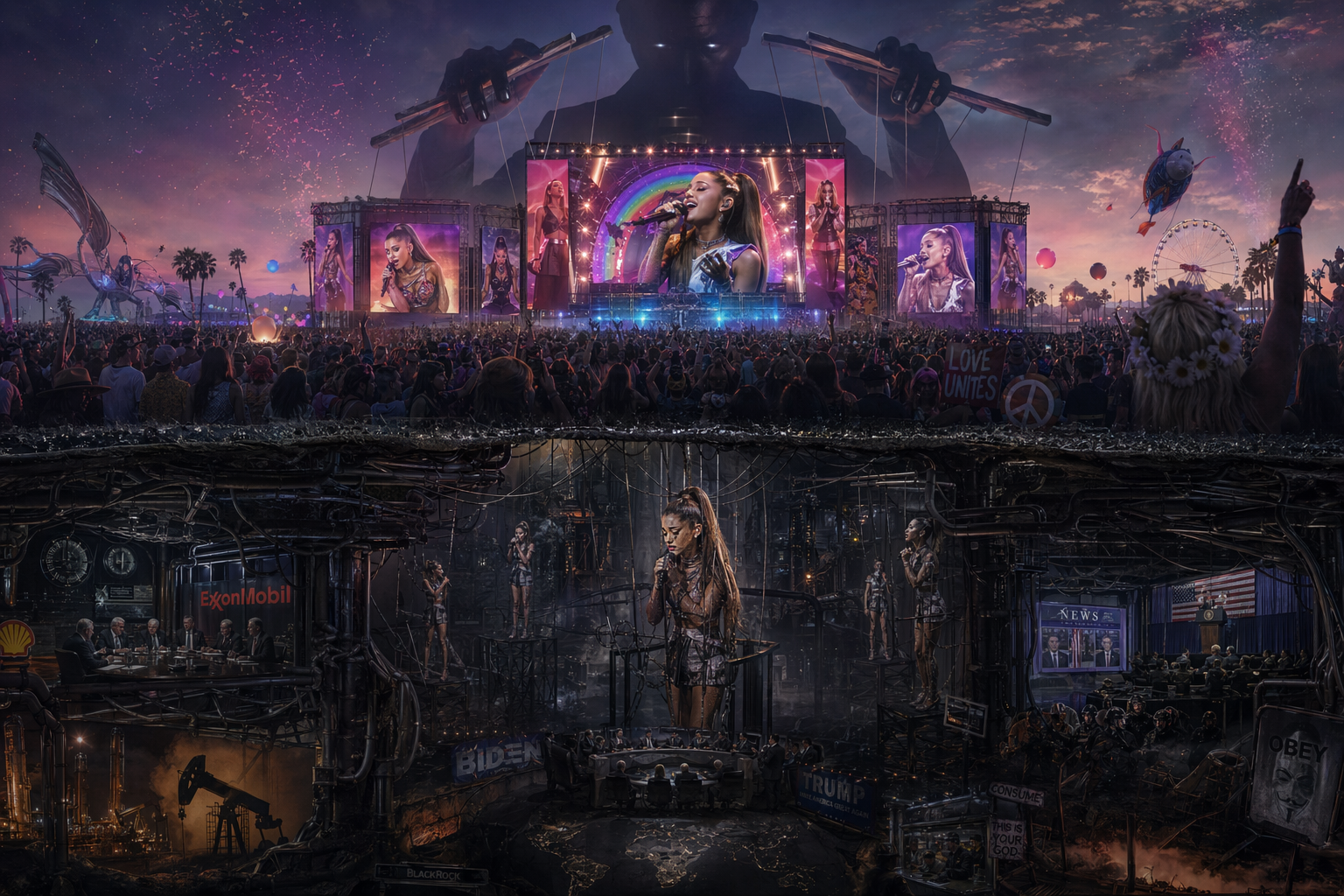
This is where the discomfort must become clarity. The issue is not that Anschutz holds a position. He has been consistent, transparent, and aligned with his worldview through both capital and action. There is a coherence there, whether one agrees with it or not. The fracture appears in those who stand on his stages, accept his funding, amplify his platform, and then speak against the outcomes that his capital is designed to produce. They are not merely adjacent to the system. They are sustaining it while publicly condemning it. This is not activism. This is participation dressed as resistance. It is hypocrisy.
When an artist headlines Coachella, they are not simply performing music. They are legitimizing an economic engine that generates hundreds of millions of dollars, a portion of which inevitably flows through ownership structures that reflect Anschutz’s broader ideological commitments. According to Forbes, Anschutz’s wealth is deeply tied to entertainment holdings, including AEG Presents, which operates Coachella. Revenue is not abstract. It moves, it accumulates, and it expresses intent. To stand on that stage is to enter that flow.
The argument that an artist is “just performing” collapses under even modest scrutiny. These are individuals with immense leverage, cultural reach, and financial independence. They are not emerging voices navigating survival. They are architects of culture. If a collective of top-tier artists refused to participate, the structure would be forced to evolve. If they redirected their influence toward independently owned festivals aligned with their stated values, the industry would follow. The absence of this shift is not a failure of imagination. It is a decision.
There is a deeper layer to this, one that extends beyond any single festival or figure. Money has become the only universally honored value system in modern civilization. It is the one principle that dissolves ideological boundaries with remarkable efficiency. Individuals who would never share a stage in a political arena will stand side by side when the compensation aligns. Causes that are framed as existential in speeches become negotiable in contracts. The moral language remains, but the financial behavior reveals the truth.
This is why hypocrisy is not a minor flaw. It is a destabilizing force. When positions are unclear, when actions contradict declarations, when systems are sustained by those who publicly condemn them, the possibility of genuine resolution collapses. Agreement becomes impossible because honesty is absent. Even disagreement requires clarity to function. Without it, society drifts into a performance of values rather than a practice of them.
The public is not exempt from this structure. Every ticket purchased, every stream, every moment of attention is an investment. To support an artist is to support the systems that enable their platform. This does not require perfection. It requires awareness. If an individual claims alignment with certain values while consistently financing their opposition, the contradiction is no longer external. It becomes internal.
There is also a question of imagination, or perhaps courage. The same artists who headline Coachella possess the capacity to create alternative platforms at scale. They have the resources, the audience, and the cultural authority to design gatherings that are transparent in purpose and aligned in outcome. The absence of such efforts reveals a prioritization that is rarely spoken aloud. Profit remains the organizing principle, even when it conflicts with the narratives being sold.
This is where a different model becomes necessary. The vision behind Compassicon is not to replicate the existing system with minor adjustments, but to expose its failures by reassigning purpose at the structural level. A festival is not inherently problematic. It is a tool. The question is where its energy is directed. When revenue is transparently tied to resolving tangible issues such as homelessness, ecological restoration, or the dismantling of factory farming systems, the gathering becomes an instrument of alignment rather than contradiction. It removes the illusion and replaces it with accountability.
The standard for such a model is not ideological perfection. It is coherence. It is the ability to trace the path from action to outcome without encountering a fracture in intent. This is what allows individuals to engage without compromising themselves. It is what transforms culture from a marketplace of contradictions into a field of shared direction.
What stands before us is not a scandal in the traditional sense. It is a mirror. Coachella Valley Music and Arts Festival is simply a highly visible expression of a pattern that exists across industries, institutions, and daily life. The question it raises is not limited to artists or owners. It extends to anyone who claims a position while participating in its erosion.
If truth is to have any function in shaping a more harmonious world, it must begin with alignment. Not in rhetoric, but in behavior. Not in moments, but in systems. Anything less is performance. And performance, no matter how convincing, does not change what the money eventually builds. The question is no longer what they stand for. It is what you are willing to fund.