

Mother Teresa, canonized as Saint Teresa of Calcutta, is globally revered as a symbol of selfless compassion. However, a documented critical perspective reveals a significant disconnect between her public persona and the operational reality of her missions.
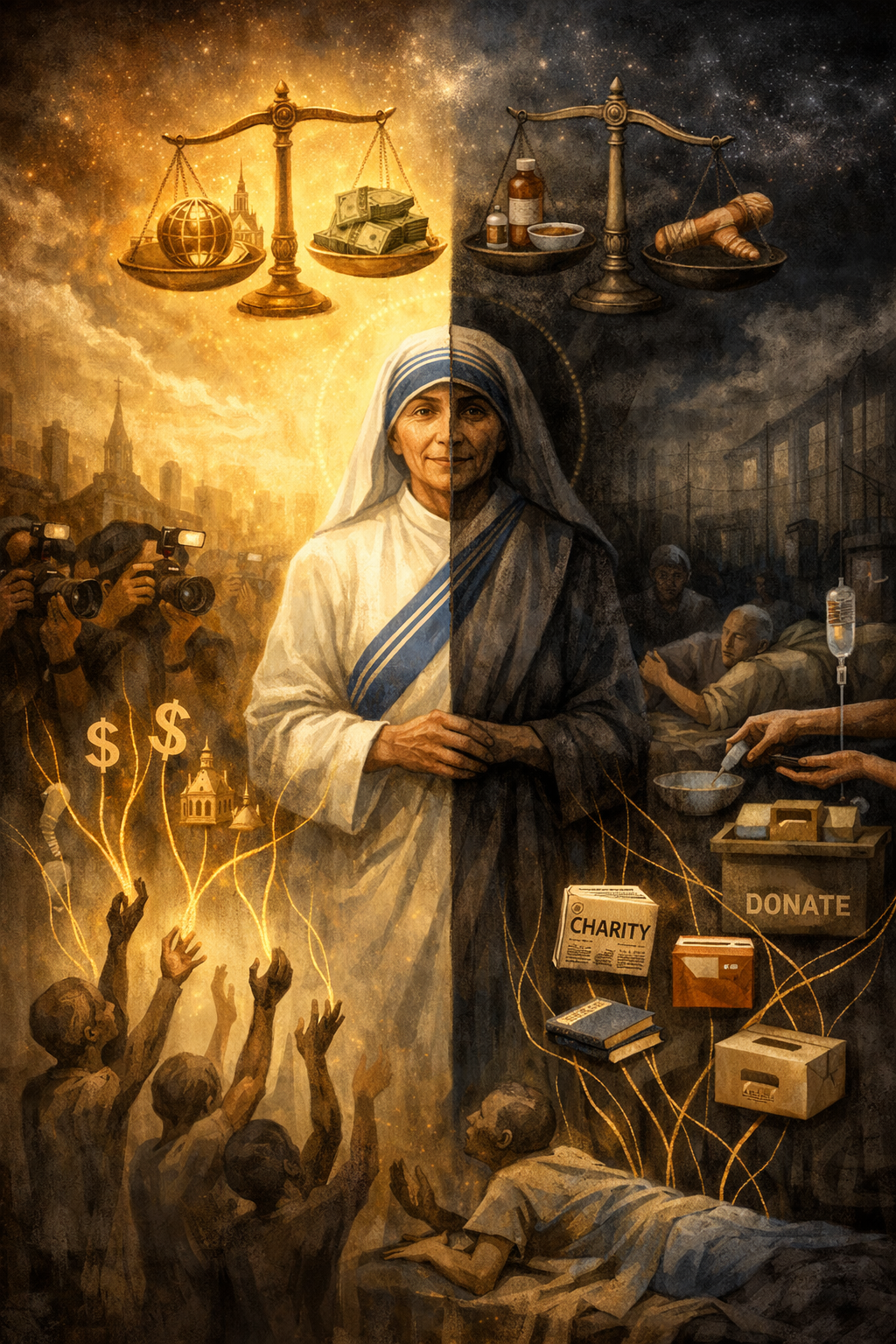
Critics like Dr. Aroup Chatterjee and Christopher Hitchens have highlighted that her Homes for the Dying were not medical facilities intended for healing, but rather primitive shelters rooted in a theology that viewed suffering as a spiritual gift. She famously described terminal pain as the “kiss of Jesus,” signifying that a person had come so close to Christ on the Cross that He could reach out and kiss them. In her view, this endurance was a beautiful token of love and a sharing in the passion of Christ, possessing a redemptive value that could be offered up for the salvation of souls or the sanctification of the Church.
This theological glorification of pain created a profound double standard in medical care. While patients in her clinics were often denied basic painkillers and subjected to substandard hygiene, such as the reuse of unsterilized needles, Mother Teresa herself sought world-class medical intervention when ill. Her history of receiving advanced treatments, including a heart pacemaker in Kolkata and experimental heart surgery at the Scripps Clinic in California, stands in direct opposition to the “beauty of suffering” she prescribed to the poor. To her detractors, this suggests that the “kiss of Jesus” was a spiritual grace intended for the destitute, while the benefits of modern science were reserved for the leadership (even if Scripps waived all her medical care fees).
Financially, her organization, Missionaries of Charity, operated with significant opacity. Despite raising hundreds of millions of dollars from donors, including controversial figures like Charles Keating, there is little evidence that these funds were used to modernize her clinics. Researchers suggest that much of the wealth was transferred to the Vatican Bank or used to open new religious convents globally, prioritizing the institutional expansion of the Church over the physical alleviation of the poverty she purportedly championed. This systemic choice meant that the redemptive suffering of the poor remained unmitigated by the very wealth their plight helped generate.
Modern biographers, most notably Brian Kolodiejchuk through his analysis of her private correspondence, have further complicated this legacy by revealing her private darkness—a decades-long spiritual crisis where she felt a total absence of God. These biographers describe a woman who lived in a state of spiritual desolation while publicly projecting a persona of divine joy. Critics argue this revelation suggests her outward glorification of suffering was a psychological projection of her own internal desolation; by framing the agony of the poor as a “kiss from Jesus,” she may have been attempting to find meaning in a silence she found unbearable in her own life. This creates a final, tragic layer of hypocrisy: While she marketed a certain joy in suffering to a global audience, she was internally wrestling with a sense of spiritual abandonment, suggesting that the compassionate truth she sold was a reality she herself struggled to believe in. This does not necessarily negate her commitment or the scale of her work, but it does challenge the simplicity of her narrative. It suggests a figure navigating deep personal struggle while simultaneously shaping a global theology that asked others to find beauty in the very suffering she herself could not resolve internally.
Ultimately, Mother Teresa’s legacy demonstrates the immense power of media and marketing in a capitalist framework to transform systemic neglect into a compassionate truth. By branding the misery of the poor as a spiritual virtue, her image was curated to satisfy a global desire for a saintly icon, even when her practices diverged from the egalitarian and healing-focused ministry traditionally associated with the teachings of Jesus. This reality suggests that with enough financial and institutional backing, subjective hypocrisy can be effectively rewritten as an irrefutable moral standard.
The enduring question, then, is not whether she helped the poor—she undeniably did—but whether the model of care she embodied was ever truly aligned with the deeper ethical responsibility to reduce suffering wherever it can be reduced. Because there is a subtle but profound difference between being present with suffering and allowing it to remain when it no longer has to. Her legacy, when viewed beyond the image, forces us into an uncomfortable reflection not only about how compassion is defined, but about who holds the authority to define it, and whether the elevation of suffering can ever exist alongside a genuine commitment to human dignity.
From a Compassiviste lens, this tension cannot be softened. Compassion that does not move toward the elimination of suffering, especially when the means exist to do so, begins to shift from virtue into justification. It becomes a language that soothes the observer more than it serves the one who is suffering. And this is where the question expands beyond one individual and begins to reveal something far more systemic. What we are witnessing is more than a simple personal contradiction, it is a model that has been repeatedly validated, where suffering is not only alleviated, but also preserved, framed, and at times unconsciously sustained, because it continues to generate meaning, attention, and resources.
In such a reality, suffering becomes more than a condition—it becomes a currency. It draws funding, builds institutions, strengthens identities, and reinforces narratives that the world is often more comfortable consuming than confronting. And within that structure, the performance of compassion can quietly begin to outweigh its impact. The image becomes cleaner than the outcome. The story becomes more powerful than the lived experience. And without deliberate awareness, we begin to participate in a system that does not necessarily seek to end suffering, but to manage its visibility in ways that remain emotionally and socially acceptable.
This is where moral accountability can no longer be deferred. Here, the question is no longer about whether someone believed in the beauty of suffering, but whether we continue to uphold environments that allow such beliefs to shape real human conditions. Whether we continue to admire compassion without measuring its consequences. Do we continue to give power, funding, and legitimacy to institutions that are rarely required to demonstrate the actual reduction of the suffering they claim to address?
We must transition compassion from symbolism to responsibility. This requires simply that care be measured by tangible change and not by intention or narrative. It calls for a shift away from systems that quietly reward appearances, including those shaped by financial incentives, institutional expansion, and the subtle economics of attention, and toward a model where the only acceptable outcome of compassion is the steady, visible reduction of suffering itself. Because at its core, compassion is meant to minimize or eliminate unnecessary suffering, not appreciate suffering through meaning.