

One day, I found myself standing in the produce aisle of a supermarket, watching what might be one of the most revealing rituals of modern civilization: the selection process. Next to me, a woman was examining tomatoes with the seriousness of a museum curator authenticating ancient artifacts. One tomato was lifted, rotated slowly under the fluorescent lights, studied carefully, and then returned to the pile. Another followed the same ritual of lift, rotate, and inspect, until a slight wrinkle or a minor imperfection appeared and the tomato was rejected with finality. Then another tomato emerged from the pile, perfectly colored, symmetrical, pleasing to the eye, and it was placed gently into the bag like a chosen heir to the throne.
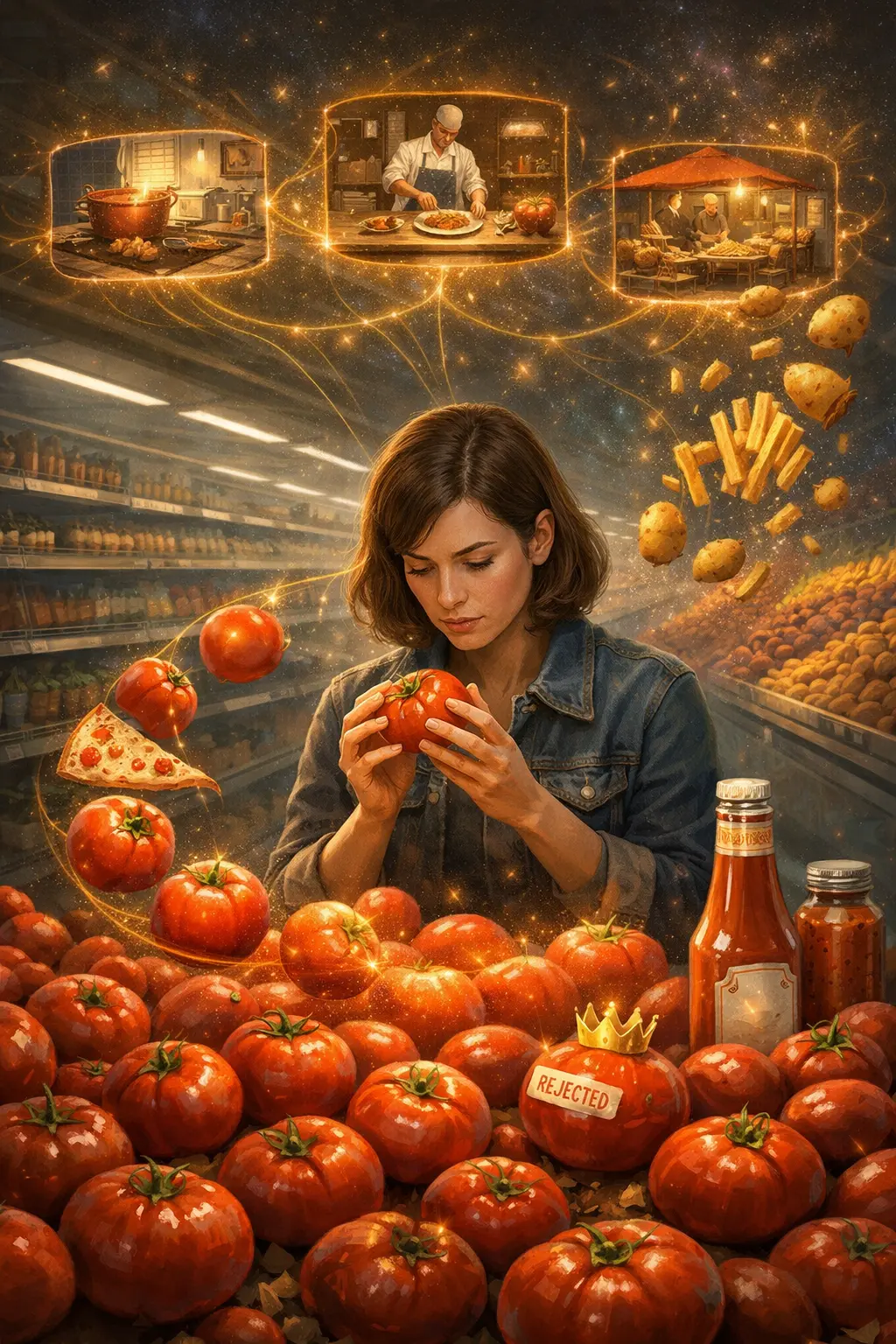
What fascinated me was not the act itself; most of us perform this ritual. It was the silent philosophy behind it. In that moment the woman had unknowingly become a tiny capitalist empire, presiding over a basket of tomatoes that had suddenly turned into a marketplace of judgment. Each tomato was evaluated, ranked, accepted, or dismissed according to an invisible standard that none of the tomatoes had agreed to and that, frankly, exists mainly in the imagination of modern consumers. One deserved selection; another was returned to the anonymous masses. The rejected tomatoes rolled back into the pile like unemployed citizens of the produce economy, quietly waiting for the next judge to appear.
But then the deeper irony revealed itself, the kind of irony the universe seems to enjoy presenting to us when we slow down long enough to observe the absurdity of our habits. The tomatoes she rejected will almost certainly return to her anyway. Perhaps tonight. Perhaps tomorrow. Perhaps disguised in a form she will never suspect. The slightly dented tomatoes may already be simmering somewhere in a stainless steel pot, destined to become the tomato sauce on the pizza she orders later in the week. Others may be quietly transforming into pasta sauce in a jar with a romantic Italian name printed across the label.
If we widen the lens further, the same karmic comedy appears with potatoes. The rejected potato from one basket returns triumphantly as french fries, or perhaps reappears as the filling inside a Punjabi Samosa served somewhere else in the city. The supermarket shelf, after all, is only the first chapter of a vegetable’s destiny.
Human beings behave as if the act of choosing establishes a hierarchy of existence. Yet the universe does not appear particularly interested in our hierarchies. It operates on circulation, not rejection. The tomato does not disappear because we declined it, and the potato does not vanish because we preferred a smoother one. They simply take another route back to us through the vast and efficient system that feeds our species. What appears to us as rejection is often merely redirection. This is the karmic comedy of consumer capitalism.
Modern capitalism trains us to believe that choice equals control and that control equals superiority. We stand before shelves and baskets as if we are sovereign decision-makers ruling over realms of products, believing that our selections shape reality itself. But the system is far larger than our momentary preferences. The tomato we rejected is still part of the same agricultural and economic cycle that will feed us later. It simply returns through another door—perhaps in a pizza box, perhaps in a jar of sauce, perhaps in a dish prepared by someone we have never met. What we call rejection is often just a temporary detour within a much larger circulation of nourishment.
Seen from this wider perspective, the moral theater of the produce aisle becomes humorous. The universe is not nearly as judgmental as we are. It wastes nothing. The sun does not grow a premium tomato and a discount tomato. The rain does not water vegetables according to supermarket aesthetics. Soil does not hold corporate meetings about cosmetic imperfections or conduct performance reviews on carrots that grew slightly crooked. Nature produces abundance; humans invent categories.
And yet, despite all our sorting and ranking and selecting, the cycle corrects us behind the scenes. The rejected returns. The imperfect transforms. The system closes its own loop. The vegetables continue their journey through kitchens, restaurants, factories, and dining tables, participating in a circulating system that is far wiser and more efficient than the small judgments we impose upon them.
The most honest response to this realization is also the simplest.
Next time you stand before a basket of vegetables, pause for a moment and observe the strange little economy unfolding in your hands. Then choose one that is slightly imperfect. The curved carrot. The spotted tomato. The oddly shaped potato. Take it home with a little more awareness of the karmic theater in which we are all participating.
Because whether we choose them or reject them, they are already part of the same circulating system that feeds us all. The universe is less selective than we are, and perhaps that is precisely why it demonstrates harmony more naturally.