

Modern civilization often speaks about death as though remembrance is the highest form of love available afterward. We preserve photographs, inherit possessions, revisit anniversaries, protect recordings, repeat stories, and carefully maintain fragments of those we lost as though preservation itself delays disappearance. Mourning becomes an act of protection. Memory becomes sacred territory. Yet many forms of remembrance unintentionally confuse preservation with continuation. The difference is enormous because preservation resists loss, while continuation transforms loss into participation. This explains why some human beings seem to die only once while others disappear repeatedly across generations.
The first death belongs to the body. Civilization understands this death because it is visible. There are funerals, condolences, flowers, legal documents, and long periods during which ordinary objects become unbearable because they continue existing while someone else no longer does.
The second death arrives much more quietly. It occurs when influence stops moving. When wisdom no longer appears inside another person’s decisions. When humor ceases interrupting difficult days. When courage no longer reproduces itself through imitation. When tenderness once received is never offered onward. When the unusual way someone viewed suffering, ambition, beauty, discipline, or love ceases participating in the world because nobody carried it further.
Human beings die twice: once when the body stops participating in existence and again when what made them extraordinary no longer travels through anyone else. This possibility should disturb us because influence often survives far longer than flesh ever could. Entire civilizations continue being shaped by people who disappeared physically centuries ago. Philosophers alter how strangers think. Spiritual teachers continue influencing moral imagination. Artists transform emotional landscapes long after becoming ash. Revolutionaries continue unsettling complacency. Even ordinary people whose names never entered the history books remain alive through habits inherited by children, kindness replicated unconsciously, perseverance repeated during hardship, and values transmitted between generations. Influence survives because someone carried it. Someone decided that what they received was too valuable to remain private. Someone became the vehicle through which another person continued participating in the world, despite physical absence.
This is where modern mourning becomes strangely incomplete. We become guardians of memory when we should also become distributors of influence. We preserve people carefully inside ourselves while overlooking the possibility that the deepest expression of love after losing someone may be allowing others to encounter them too. Not literally, but through continuation, transmission, and embodied inheritance. This thought initially feels uncomfortable because grief often behaves protectively. Love can become possessive after loss. We keep memories close because sharing them sometimes feels like surrendering the final traces belonging only to us. The dearly departed become sacred territory. Their sayings, humor, unusual kindness, strange rituals, stubborn discipline, peculiar way of interpreting the world, all remain guarded inside private remembrance. Yet nature repeatedly demonstrates a different principle for survival.
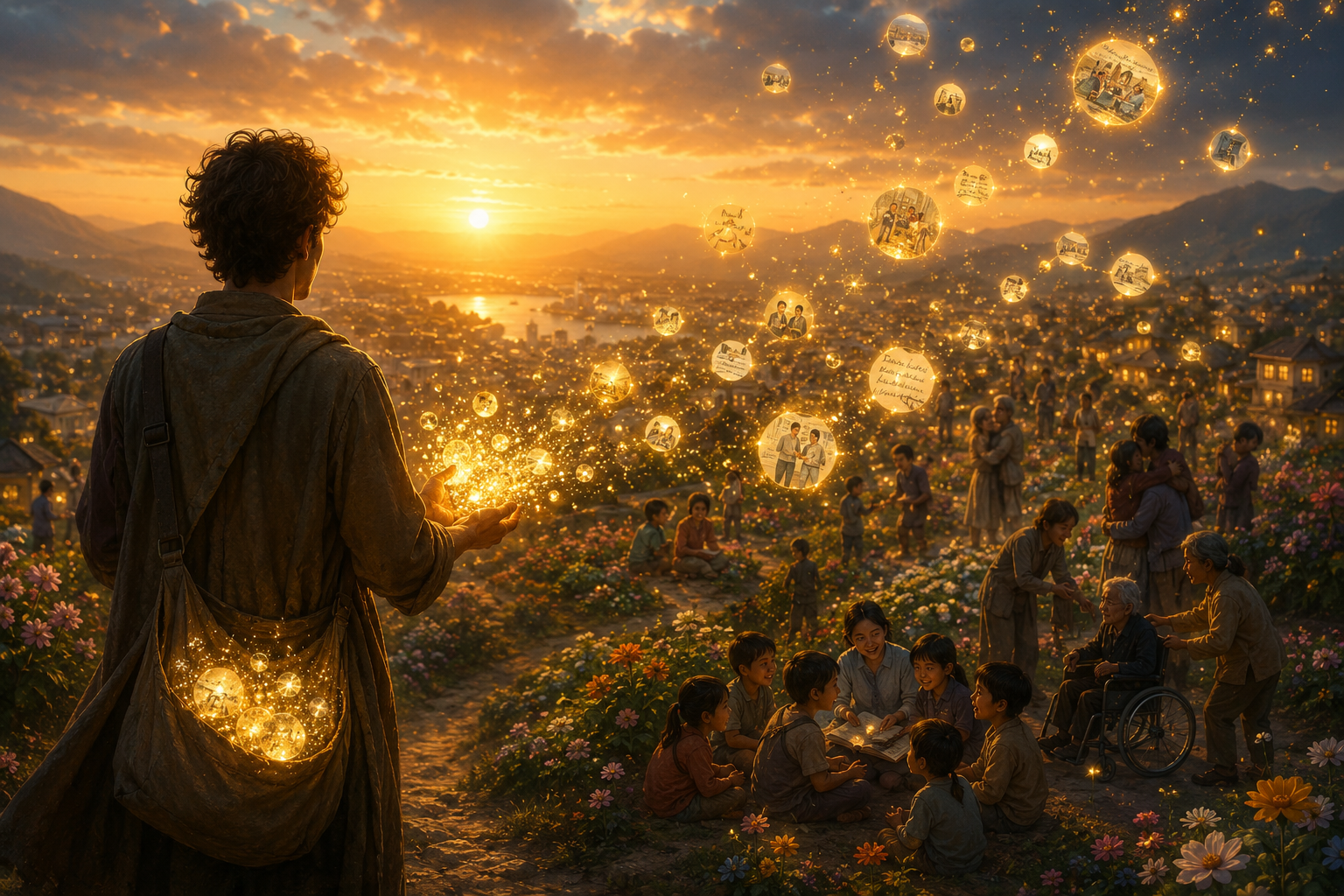
Flowers do not survive because they are protected. Flowers survive because they are shared. The bee performs something extraordinary. It does not preserve the flower by remaining forever beside it. It carries what was essential elsewhere. Through movement, life multiplies. Through distance, continuation becomes possible. Through participation, something singular becomes forest. Human influence functions similarly. The people we lose leave behind more than memory. They leave behind pollen. A way of seeing suffering. An unusual generosity. Defiance against hopelessness. The sentence they repeated often. The strange humor that made unbearable moments survivable. The stubborn compassion of a grandmother. The courage of a friend who remained kind, despite carrying invisible pain. The ambition of a parent who believed survival itself was insufficient without purpose. These things do not disappear automatically when bodies disappear, but they require carriers.
This is the hidden responsibility grief eventually places before us. Not immediately because mourning often resembles drowning before it resembles understanding. Survival requires all available energy. But eventually grief begins asking a difficult question: Will you become the vehicle through which something beautiful from this person reaches places they never reached themselves? The greatest memorial is not a monument, photograph, preserved possession, or annual act of remembrance. The greatest memorial is continuation. The most loving thing we can do after someone dies is allow strangers to benefit from their influence. And the happiest form of grief is witnessing flowers bloom in forests the original flower never lived long enough to see.
Modern civilization has become remarkably skilled at archiving people while becoming strangely poor at continuing them. Entire industries now exist around remembrance. We build memorials, curate digital legacies, preserve photographs indefinitely, and increasingly allow algorithms to remind us who existed through yearly notifications announcing anniversaries of death. Grief itself appears expected to operate according to software updates. Memory alone may be an insufficient response to mortality.
Remembering someone privately does not necessarily allow their influence to remain socially alive. Human beings often inherit possessions from the dead while overlooking the possibility that values, habits, principles, and unusual ways of seeing the world may represent a far more important inheritance.
This is why some people continue participating in history despite physical absence, while others disappear almost entirely within two generations. The difference is rarely importance. It is transmission. The teacher whose ideas become books continues. The parent whose perseverance becomes family culture continues. The friend whose compassion changes how others treat suffering continues. The artist whose work helps strangers survive difficult years continues. The ordinary grandmother whose stubborn generosity becomes tradition inside a family continues. Influence survives because someone eventually decided that what they received should not end with them.
This realization introduces a difficult question: What medium best preserves influence? Human beings often assume permanence belongs to physical things because objects appear durable. Yet libraries have burned. Buildings collapse. Digital archives disappear. Photographs fade. Even language evolves until meanings shift. Permanence has always been more fragile than civilizations like to admit. Influence survives longest when embodied rather than stored. A principle practiced repeatedly may outlive monuments. Compassion imitated may travel further than statues. Courage demonstrated publicly may survive longer than written biographies. The deepest preservation may not occur through documentation but through participation.
This possibility transforms grief into responsibility. The mourner ceases becoming merely someone who lost, and gradually becomes someone entrusted. Suddenly mourning asks something more demanding than remembrance: What part of this person deserves continuation? Which qualities should remain private memory and which qualities should become public contribution? Not every inheritance belongs inside safes, wills, or family homes. Some inheritances belong inside strangers.
This is precisely why becoming the bee is more difficult than becoming the keeper of flowers. Preservation requires loyalty. Pollination requires movement. Preservation requires protection. Pollination requires courage because carrying influence elsewhere means risking alteration, reinterpretation, and expansion. The bee cannot guarantee where every seed will eventually bloom. Without movement, forests never emerge. The flower remains singular until something chooses participation over possession.
This explains one of grief’s strangest experiences. Occasionally we witness someone we loved appearing unexpectedly through another person years later. A sentence spoken similarly. A familiar kindness. A way of handling hardship. A philosophy repeated unknowingly. The moment feels unsettling, because for an instant, absence becomes presence again. We realize influence has been traveling beyond our awareness. The person has not returned physically, yet something essential has refused to disappear.
Modern civilization often measures legacy through wealth, institutions, public recognition, or family lineage. Perhaps legacy has been misunderstood. The most extraordinary inheritance may not be what someone accumulated but what they awakened. Eventually, possessions become objects owned by strangers. Influence becomes strangers transformed. This is why grief can become something unexpectedly hopeful over long enough periods of time. Not because pain disappears or absence stops hurting. But because one day the person we lost may begin appearing in forests they never physically walked through, helping people they never met, strengthening ambitions they never witnessed, or comforting suffering they never lived long enough to encounter. We begin to see that death interrupted their body, but participation continued elsewhere because somebody carried the pollen.
The realization that influence may survive longer than bodies should alter how we understand both grief and responsibility because it shifts the question from: “How do I preserve this person?” toward something much more demanding: “How do I allow this person to continue participating in the world through me?”
Preservation often looks backward. Continuation requires participation. One protects memory while the other risks transformation. This risk is what love asks of us because influence is not stationary. Wisdom hidden permanently becomes silence. Compassion withheld becomes indifference. Courage unactivated becomes sentiment rather than force.
Some of the most extraordinary human beings remain socially alive, despite their physical absence. Their influence has escaped ownership. Their ideas have become shared territory. Their courage has entered strangers. Their suffering has become instruction. Their unusual way of understanding existence continues through people they never met. Entire moral traditions, philosophies, movements, and acts of compassion have emerged because someone refused to allow what they inherited to end with them. The continuation of influence has always depended less upon greatness itself and more upon willingness to carry it.
This should comfort us because death may interrupt participation without fully ending it. It should agitate us because continuation places responsibility upon the living. We become, knowingly or unknowingly, architects of what survives. Human beings often imagine inheritance as something received passively, but perhaps inheritance is equally an act of selection. Every generation decides what deserves continuation. Every individual decides which influences remain private memory and which become public contribution. In this sense, grief may slowly transform into stewardship, one of the deepest expressions of love. Grief rarely disappears entirely when love was genuine. Certain absences become permanent architecture within a person. The unbearable weight of losing someone gradually becomes accompanied by something unexpected: purpose. The realization that carrying what was beautiful about someone forward honors mourning.
This explains why moments of unexpected joy sometimes emerge years after loss. The joy emerges neither from disappearance nor from pain ending, but from something recognizable appearing elsewhere. A child repeats wisdom from a grandparent they never met. A stranger is strengthened by a lesson inherited indirectly. A community benefits from principles rooted in someone long absent. An act of kindness expands beyond its original source. The moment feels strange because grief and gratitude begin occupying the same space. We recognize something extraordinary: Flowers are blooming in forests the original flower never saw.
Modern civilization frequently measures success through accumulation. More possessions. More recognition. More status. More evidence of having existed. Yet the most meaningful measure of a life is never accumulation. The value of a life may be measured by a single question: What continues because you lived? It is not asking what remains physically or what carries your name. What continues?
The parent who taught extraordinary compassion possesses a greater legacy than the executive who accumulated extraordinary wealth. That child who later embodies unusual compassion may shape lives invisibly through hundreds of interactions they never witness. Ordinary people may continue shaping the future through influence so subtle it escapes recognition entirely. Human beings may underestimate how much of civilization survives through invisible inheritance rather than formal achievement. And this returns us to the bee. The bee never fully witnesses the forests emerging from its participation. It moves to sustain life. It carries because carrying prevents disappearance. Much of what becomes abundant later begins as something transferred carefully from one place to another, without certainty regarding outcome. Influence behaves similarly. We share stories, principles, humor, courage, kindness, discipline, curiosity, and hope, without knowing where they will eventually bloom.
This means the deepest expression of love after death is becoming the continuation. Becoming willing to carry pollen into places the original flower never reached. Human beings do die twice, but the second death is not inevitable because it arrives only when influence stops traveling. The social responsibility of those who remain is ensuring that what was beautiful does not end unnecessarily. The happiest form of grief is one day standing inside a forest and realizing that pieces of someone you loved are alive everywhere around you.